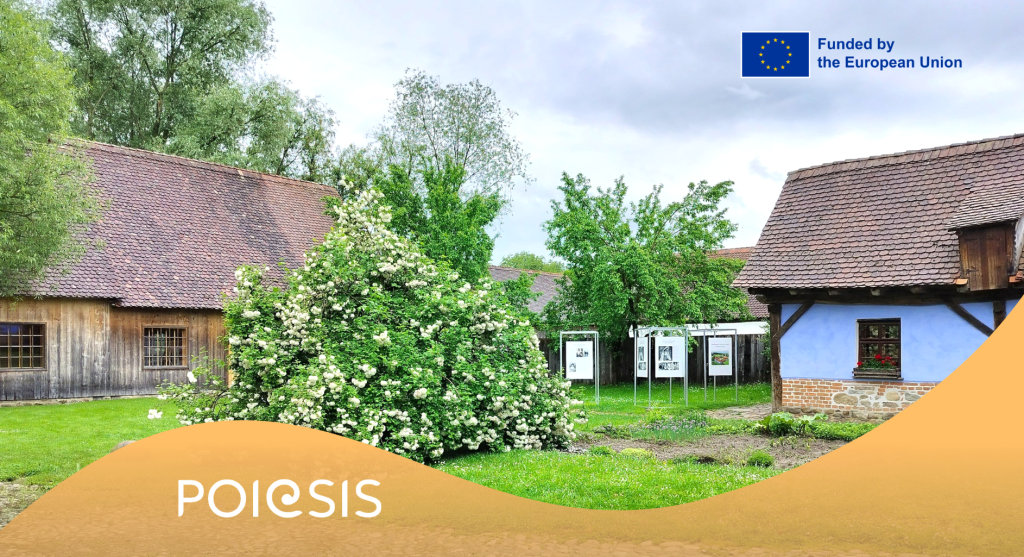
Transnational Project Meeting taking place in Viscri, Romania, between 28th and 29th of May 2025
Alba Eglesia Foundation was a host organisation for the Transnational Project Meeting that took place between 28th and 29th of May, 2025, in Viscri, Romania.
The partnering organistions discussed the project methodology, the logistics of deploying the pilot workshops, the resources to be put into place for the workshops and the artists that will conduct the workshops in each country. Besides the technical discussions, the 2 partners coming to Romania also discovered the UNESCO Site of Viscri and its cultural and artistic scene.
Day 1 of the Meeting
The first part of day 1 was a general discussion about the project methodology, a possible timeline of the pilot workshops, and main resources to be used for the workshops.


The methodology used in the “POIESIS” project is Expressive Arts. Expressive Arts is based on the use of multiple arts such as drawing, painting, dance, writing, photography, etc., in order to understand the inner experiences of individuals, to allow them to be creative, and to transform art and artistic expression into powerful tools for healing and transformation.
This methodology was specifically tailored to the main contexts and the communities in which the partnering organisation work: Austria is focused on immigrant and refugee communities, Romania is focused on cultural heritage and minority inclusion, Italy is focused on arts and environmental sustainability in rural areas.
Through the Expressive Arts Methodology, the ultimate goal of the project is to show that art in general can bring well-being, inclusion and cultural revival. This methodology is co-created by all 3 partnering organisations and can be adapted to communities and particular contexts across European countries.
After the general meeting, the participants from all 3 partnering countries went to the deViscri Shop, which is located in the village of Viscri and that aims to be a creative hub for artists and craftsmen to sell their art creations and pieces and for workshops and other artistic activities. The president of the Alba Eglesia Foundation, Octavian Angheluș, presented the cultural ad artists scene of Viscri and more details about the local community of artists.


The participants also discovered one of the most important tourist attractions in the village, the King’s Charles the 3rd Museum. The participants discussed with the local guide about the museum and learned more about the temporary exhibition held there, called, “Lee Miller’s Romania” – an incursion into the Romanian rural world between 1938 and 1946 as depicted by Lee Miller, the famous American photographer.


 In the last part of the day, the representative of the partnering organisations went on a trip to another UNESCO Site in the region, the city of Sighișoara, known for its medieval architecture, craftsman guilds and connections with Vlad Țepeș, the famous Romanian ruler.

Day 2 of the Meeting
The first part of day 2 was reserved for a tour of the village of Viscri. The partnering organisations from Austria and Italy had the chance to visit the Saxon Fortified Church and also to take a walk on the streets of the village.


After this, the partnering organisations had an online meeting with Linda Velásquez Ramos, one of the trainers, to discuss the implementation of the pilot workshops and the project methodology. During this online meeting, the trainer presented the vision in which the project partners contribute with 3 major components that set the foundation for the collaboration with future beneficiaries: integration and emotional wellbeing (Austria); cultural identity and local traditions (Romania); ecology and local materials (Italy).
Each partner will use their component as a blueprint for deploying pilot workshops focusing on various aspects of the interplay between inner and outer “landscapes” of the human being such as: living gallery, inner refuge, self reflection, emotional map, bridges between generations, roots and origins, etc. These aspects will eventually bring to surface the traits of each participant at the workshop, increase their level of wellbeing and facilitate social inclusion.
After the online meeting with the trainer Linda Velásquez Ramos, the partners from Austria and Italy met with Irina Motroc, local artist from Viscri and the one that will also conduct the pilot workshops for the Romanian participants alongside with photographer Tavi Anghelus. Irina Motroc is a multidisciplinary artist that uses engraving, illustration, installations, etc. as her main art mediums. The artist presented her portfolio and the main topics she addresses in her art works.


The Transnational Project Meeting from May 2025 was the perfect occasion for our organisation to speak with the project partners, to present them the UNESCO Site of Viscri and what it as to offer in terms of culture and art and to set up the stage for the next important activity: pilot workshops with beneficiaries from each partnering country.
About the project partners
Creative Art Farm
Creative Art Farm in Italy APS (CAFI) is an organisation that focuses on arts, culture and technology and that aims to create, based on them, growth and inclusive communities for people from all backgrounds. The organisation was initially established under the name of “Arts in Rome” in 2015 and successfully integrated into the artistic community of the capital city. After the Covid-19 pandemic and the systemic shifts in the society, the organisation moved to rural Italy, in Tuscany, in order to regain the harmony between nature and humanity and to become an important hub of arts in rural areas.
Today, Creative Art Farm wishes to empower and educate people with fewer opportunities with the support of arts, culture and technology, to create bridges between the cultural and creative industries across Europe, to promote European values, the need for sustainability and non-formal education. The NGO has 2 branches, one in Italy and one in Estonia.
IRARU
IRARU is an organisation that aims to empower people with fewer resources and opportunities through arts and culture, to promote social integration and cultural diversity, and to create inclusive communities at both local and European levels. The organisation was founded by a group of migrant artists who believe that all people are artists and that the desire to create is found in all of the people. The name of the organisation, IRARU means “people that comes and goes”, a reference to the mobility of people in the current times, the movement of ideas and the transient side of life.
IRARU creates, co-produces and organises workshops, training and events, within the fields of music, theatre, art, design, literature, etc. and implements projects especially for youth coming from poor backgrounds, migrant communities and vulnerable groups. At an European level, IRARU implements projects with multiple other organisations, mainly in the field of arts, culture and youth. The NGO has 2 branches, one in Austria and one in Spain.
DISCLAIMER
“Poiesis: Expressive Arts for Youths” will take place from 2024 to 2026 and is funded through the Erasmus+ programme.
Co-funded by the European Union. Views and opinions expressed are however those of the author(s) only and do not necessarily reflect those of the European Union or the European Education and Culture Executive Agency (EACEA). Neither the European Union nor EACEA can be held responsible for them.