
Erasmus+ LIVE 2025 – Project activities and results
Between 29th of June and 5th of July 2025, 24 participants from Austria, Turkey, Romania, Poland and Ukraine (special guest) engaged in the Erasmus+ LIVE Project, which took place in Vienna, Austria.
The acronym of the project, LIVE, stands for “Linguistic Integration for Vibrant Education”. The project promoted multilingualism and multilingual education through innovative AI-powered language learning and aimed to support individuals who speak multiple languages and who come from diverse backgrounds and communities from Europe.
Participants got a chance to take part in a wide range of activities, test the special app designed by the Turkish partner, interact with each other, know more about the European Union, and explore the cultural and artistic beauties of Vienna, of the most famous capital cities in the world.
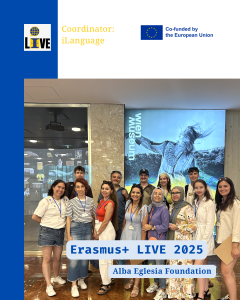


Day 1 of the project
The first activities started on Monday, 30th of June 2025, with a welcoming session where the organising team from iLanguage shared more about the project goals and activities and the participants presented themselves. Following the welcoming session, the first workshop of the project kicked off and invited participants to reconsider how the languages they speak shape their identity and expression.
The workshop called “Linguistic Living Spaces” was led by Carola Koblitz, president of the iLanguage Association and revolved around how the languages we speak on daily basis and our culture influence the way we perceive the space, and in particular, the familiar space, such as our home, office, school, community centres, etc. Through visual mapping, the participants understood their personal language use and reflected on these spaces with a new vision, reconsidering what they knew and felt about the languages they speak and their culture. In the second part of the day, the participants switched from 2D to 3D and created 3D representations of physical maps of the languages they speak using paper, cardboard, glue and natural materials they found around them.


Day 2 of the project
The second day of the activities brought for participants a session with a presentation of the iLanguage Association and its mission and another special workshop called “Language Portrait”. Language portrait was first popularized by researcher Brigitta Busch. This workshop focused on linguistic identities and how multilingual individuals identify and express these identities. By using a figure in the shape of a body, participants pointed out their identities by assigning colors, emotions and associations to each language they speak.
This creative activity transformed the abstract of a language acquisition and experience into a playful and artistic experience, where people engaged on a more profound level with their identity/ identities and recognized what languages mean to them.

Day 3 of the project
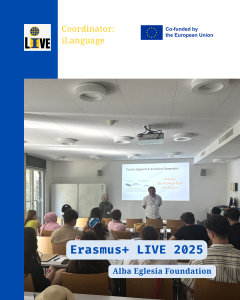
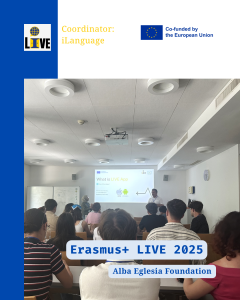
The third day of activities brought technology into focus as participants learned more about Artificial Intelligence, its history and how humans interact with AI. Interaction of humans with AI is of particular interest for multilingualism as written text in a specific language is at this moment the main tool for interacting with intelligent agents. The Turkish partner presented the history and development of AI, from the first philosophical and mathematical foundations, to modern day tools powered with and by AI.
Then, the most sought after event took place when the LIVE App was launched and tested by the participants who also gave their first feedback. This app was designed to support its users in building language confidence through self-reflection, interactive content, and AI-powered support. Additionally, the app emphasizes how users construct their identity once with the acquisition of a new language.

Day 4 of the project
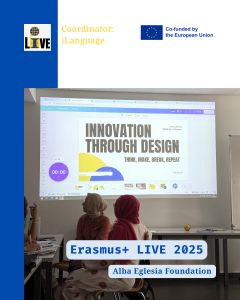
The fourth day of the project was dedicated to design and multilingual education. The workshop called “Innovation through design” sparked the attention of the participants by centering on design and how it influences us. Participants learned how spoken languages and design can influence the learning process individually and collectively and offered, during a pitch session, ideas for a design adaptable to current learning requirements and today’s digital world.
The workshop “Exploring solutions Inherent Language in Education” presented some potential solutions for multilingual education and how people can make the best of their language acquisition and navigate the identity-building process.

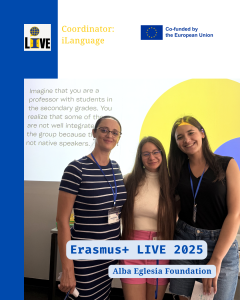
Day 5 of the project
The fifth day of the project was centred around the European Union identity and the closing ceremony in which the coordinator, the partnering organisations and the participants immersed themselves into an emotional journey of reflection upon the whole project. The venue of the day was Europa Experience – the exhibition and trade centre where visitors can learn about the history and development of the European Union and participate in multimedia experiences delving into European Union affairs such as democracy, civic liberties, works of the European institutions, legislation, EU Representatives, multilingual diversity, diplomacy and much more. Participants had the chance to immerse in several experiences and explore the variety of educational spaces within the building. During the closing ceremony, all of the participants reflected upon the project activities and shared their ideas and emotions regarding the things that link themselves to the project and to Europe as a whole.
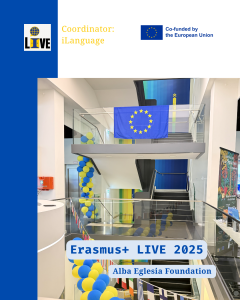
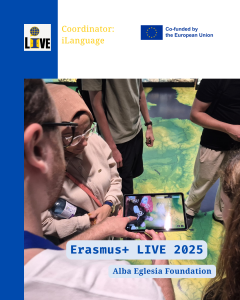
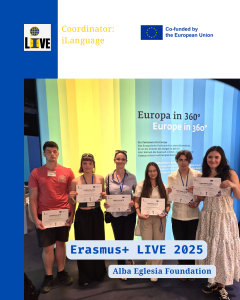
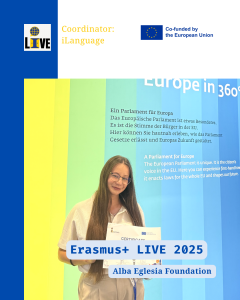

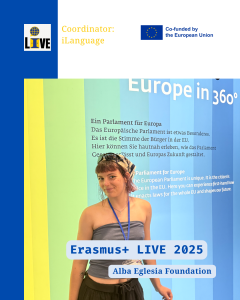
Besides the main activities, participants participated in roundtables, energizers, free discussions and also spent free time visiting Vienna and some of its most important tourist attractions.




Project results
The project had the following results:
- Understanding by the participants of the value of all spoken languages;
- Fostering an environment in which individuals feel confident about their knowledge and language level;
- Increasing the creativity and reflection of the participants upon the language acquisition and language learning processes;
- Creating and strengthening non-formal spaces for education and multilingual education;
- Promoting ownership of the languages spoken by participants;
- Promoting a language-rich environment and cultural awareness;
- Understanding by the participants of the history and development of AI and in particular chatbots;
- Increasing the awareness of the youth workers as agents of change and equipping them with non-formal tools for multilingual education;
- Launching of the LIVE App.
The Alba Eglesia Foundation is proud to be part of this Erasmus+ project and to support multilingual education and learning through technology. By sending our group of participants from Romania, we allowed them to increase their knowledge and expand their horizons, while we are grateful for the way they represented our organisation. We like to thank our participants, partners and to the project coordinator for making this project possible.

Coordinator of the project
iLanguage – Multilingualism, Integration and Diversity
http://www.i-language.eu/
https://ilanguage.live/
live.ilanguage@gmail.com
https://www.instagram.com/ilanguage.me/
https://www.facebook.com/Inherent.language
https://www.tiktok.com/@ilanguage.me
https://x.com/iLanguage_me
https://www.youtube.com/@iLanguage_me
Project partners
@wonders_of_milas
@ga.szo
@albaeglesia